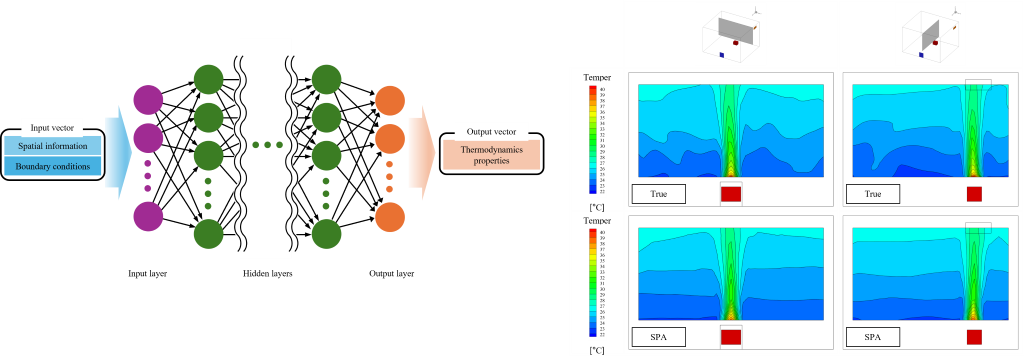
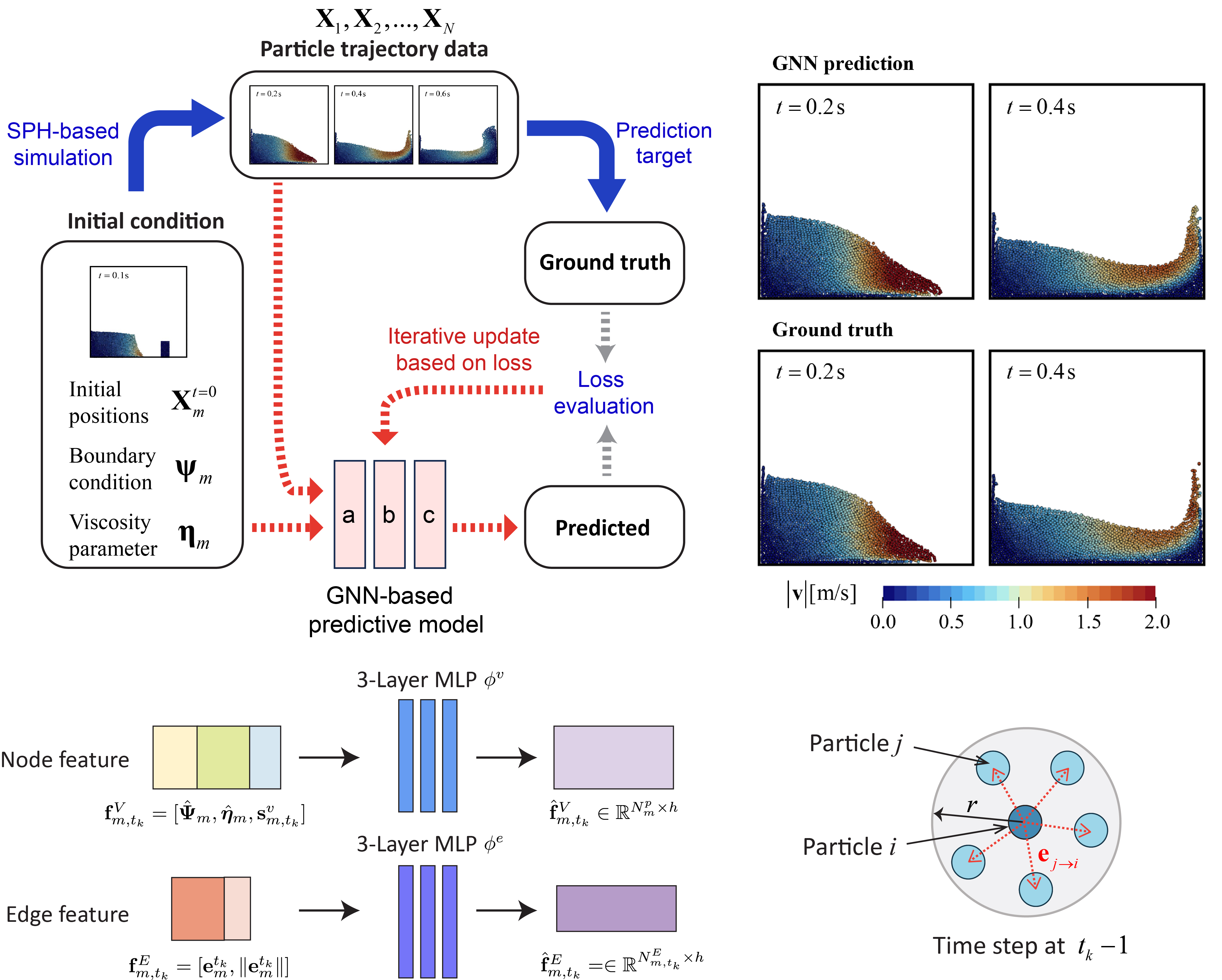
This research area integrates machine learning with computational mechanics to accelerate prediction, optimization, and design exploration. We develop hybrid pipelines that combine physics-based simulation data with surrogate models, graph-based learning, and physics-informed neural networks for high-dimensional engineering systems.
Research Topics
Physics-Informed & Surrogate Modeling
- Physics-Informed Neural Networks (PINNs)
- Gaussian Process and response surface models
- Reduced-order and surrogate-assisted simulation
Graph Neural Networks for Physical Systems
- Pore-network and microstructure graph representation
- GNN-based effective property prediction
- Contact-network learning in particle systems
- Message-passing models for transport and percolation
Hybrid Simulation + AI Pipelines
- AI-assisted microstructure optimization
- Multi-objective design under physical constraints
- Data-driven parameter inference and calibration
Digital Twin & Intelligent Engineering
- Simulation-driven digital twin frameworks
- Real-time prediction and control integration
- AI-enhanced engineering decision systems